
Case:
The Rambagh Palace Hotel, Jaipur v. The Rajasthan Hotel Workers’ Union, Jaipur
Civil Appeal No. 2626 (NL) of 1969
Court and Date:
Supreme Court of India
Decided on: January 5, 1976
Coram: Justice A.C. Gupta, Justice N.L. Untwalia, and Justice V.R. Krishna IyerService Charges
Relevant Law:
Industrial Disputes Act, 1947 – particularly concerning Dearness Allowance (D.A.) of workmen and the interpretation of tips or service charges as part of wages or management payment.
Background:
The Rambagh Palace Hotel, Jaipur, a prestigious five-star establishment, faced a dispute raised by the Rajasthan Hotel Workers’ Union regarding dearness allowance (D.A.). The workers argued that the rising cost of living warranted an increase in D.A.
The Industrial Tribunal, Rajasthan, partially accepted the workers’ claim and awarded them an increased D.A. after considering benefits like free food and accommodation provided by the hotel.
However, the hotel management contested the decision, claiming that tips and service charges received by waiters and staff should be taken into account as part of their income when determining D.A. The hotel argued that since the staff received significant amounts through tips, the Tribunal should have reduced the awarded D.A.
Legal Issue:
Can tips or service charges collected from customers and distributed among hotel staff be considered as payment made by the management, thereby affecting the computation of dearness allowance (D.A.)?
Key Legal Findings:
- Nature of Tips:
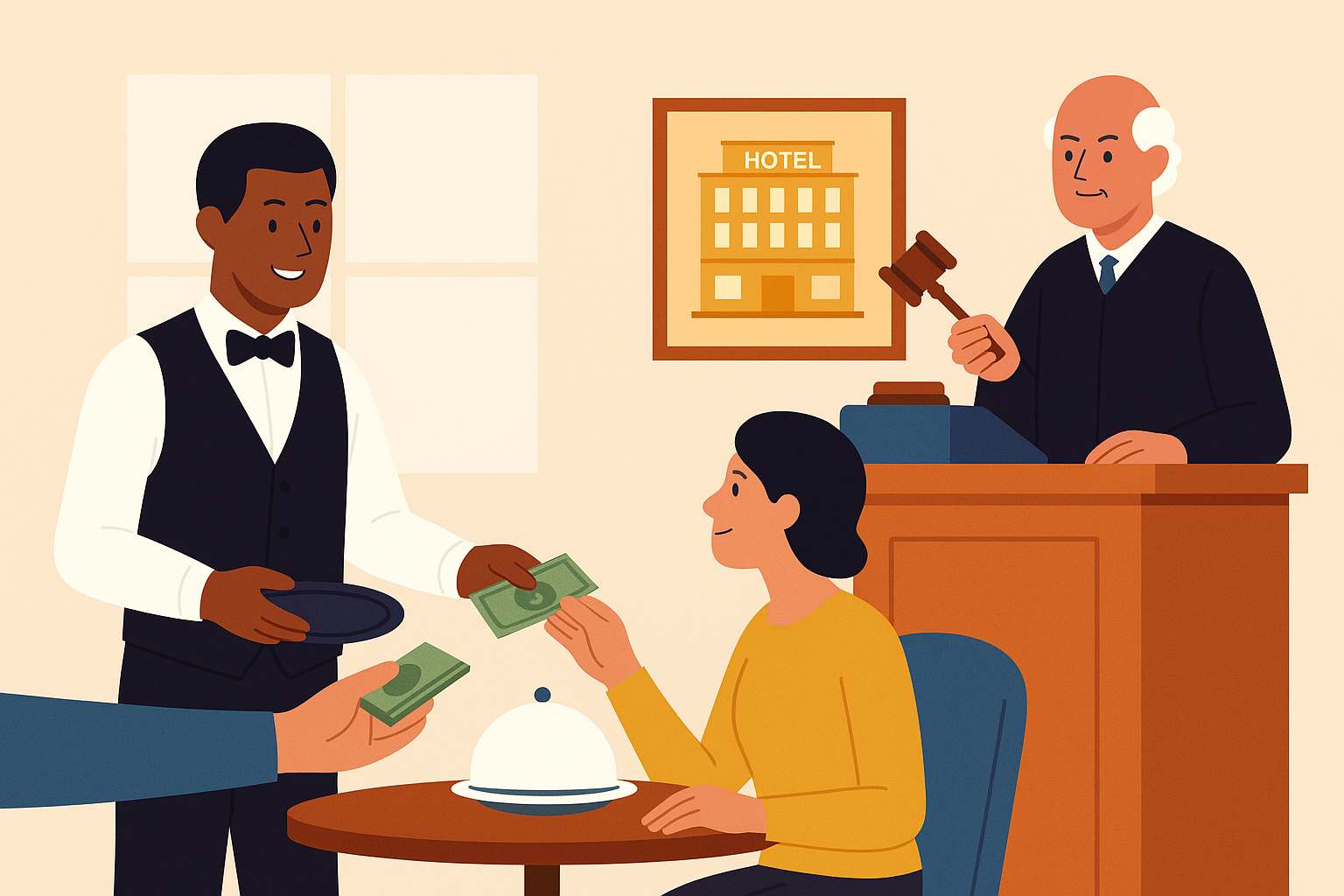
The Court held that tips are not payments made by the management from its own funds. Instead, they are amounts given by customers, collected by the hotel, and distributed to staff as intended by the payer. - Non-Substitutability for D.A.:
The Court emphasized that tips cannot replace or reduce dearness allowance. They are voluntary payments by customers and not a component of wages that the employer can use to offset statutory obligations. - Reference to Precedent:
The Court relied on Management of Wenger & Co. v. Their Workmen (1962 Su. 2 SCR 862), where it was held that while the receipt of tips could be acknowledged, it cannot serve as a substitute for D.A. or be used to diminish the workers’ entitlement. - Tribunal’s Consideration:
The Supreme Court found no evidence that the Industrial Tribunal ignored the factor of tips in its judgment. Hence, there was no justification for interfering with the award.
Judgment:
Justice V.R. Krishna Iyer, delivering the judgment, held that:
“The true character of tips cannot be treated as any payment made by the Management out of its pocket but a transfer of what is collected to the staff as intended by the payer.”
The Court dismissed the appeal, affirming the Industrial Tribunal’s decision to grant dearness allowance without deducting tip income. Both parties were directed to bear their own costsService Charges.
Conclusion:
The Supreme Court clarified that service charges or tips cannot be regarded as payments by the employer. Such amounts are gratuities from customers, intended for workers and not management contributions. Hence, they cannot justify reductions in statutory benefits like dearness allowance.
Key Learning:
This case sets a vital precedent in employment and hospitality law, highlighting that:
- Tips belong to employees, not management.
- Employers cannot offset statutory obligations (like D.A. or minimum wages) against gratuities given by customers.
- The nature and source of payment are essential in determining what constitutes wages under labor law.
In short, customer generosity cannot replace employer responsibility.
Download the PDF copy of this Case:
Join the community that’s changing the way businesses handle compliance in India.
🔗 Join the community now: https://chat.whatsapp.com/HUtBuKh58rlLVi5ykjJMMg?mode=ac_t
🌐 For more information, visit our website: Service – LaBbrio Compliance Hub
📖 Read more of our Blogs: Blogs
📜 Read more our Untold Stories: The Untold Stories
🔍 Read more our Case Studies: Case Studies
▶ Subscribe to our YouTube channel: Labbrio Compliance Hub
📩 Mail us today at: solutions@labbriohub.com
📞 Call us at: +91 81045 53709